
The Indian government has increased the export duty, or windfall tax, on diesel to Rs 55.5 per litre and on aviation fuel (ATF) to Rs 42 a litre, effective immediately, to boost domestic availability and prevent exporters from exploiting global price differences.

India's wholesale price inflation (WPI) increased to 9.87 per cent in June, up from 9.68 per cent in May, primarily due to significant price increases in non-food and food products, with food inflation alone rising to 5.49 per cent.

Indian markets on Dalal Street rallied sharply as easing tensions in the US-Iran conflict and stable oil prices boosted sentiment. Track Nifty 50 and BSE Sensex performance and key global triggers.

Indian markets on Dalal Street rallied sharply as easing tensions in the US-Iran conflict and stable oil prices boosted sentiment. Track Nifty 50 and BSE Sensex performance and key global triggers.

A proposed deal between Iran and Oman could grant Tehran control over vessels entering the Gulf through the Strait of Hormuz, according to a senior Iranian source and two regional officials who spoke to Reuters on Wednesday, in what represents one of the most significant concessions made to Iran to date.

Reliance Industries Ltd on Thursday said it has halted the use of Russian crude at its export-only refinery in Jamnagar, Gujarat, as the company moves to comply with European Union sanctions. Reliance is India's largest buyer of Russian oil, which it processes and turns into fuel, such as petrol and diesel, at its giant oil refining complex at Jamnagar.

'India has initiated a bear market and we will still go lower. It has nothing to do with the economy.'

Gold prices in the national capital fell by Rs 600 to Rs 1.64 lakh per 10 grams, influenced by tentative progress in US-Iran negotiations, which reduced demand for precious metals. However, unresolved tensions surrounding the Strait of Hormuz continue to keep traders cautious.

Some are treating the price correction as akin to a fiscal stimulus that could kick-start a new demand cycle in the economy.

The Indian government has reduced excise duty on petrol and diesel to mitigate the impact of rising global crude prices, triggered by geopolitical tensions in the Middle East. This move aims to provide relief to consumers and oil companies amidst volatile international oil markets.
Indian markets on Dalal Street rallied sharply as easing tensions in the US-Iran conflict and stable oil prices boosted sentiment. Track Nifty 50 and BSE Sensex performance and key global triggers.

Indian benchmark indices, Sensex and Nifty, closed marginally higher after a volatile trading session, driven by value buying in IT and select blue-chip counters, despite global crude price hikes and a weak rupee.

Net mutual fund inflows into active equity schemes in India plummeted by 40 per cent month-on-month in May, reaching a one-year low of 22,908 crore, primarily due to weaker lump-sum investments and increased redemptions amidst significant market volatility and global uncertainties.

Tax collection so far has been encouraging, with net direct tax receipts reaching Rs 5.21 trillion by June 17, nearly a 15 per cent increase compared to the same period last year.

For starters, the Iran situation is sure to have an impact on crude oil prices, as the world has little spare capacity.

Union Finance Minister Nirmala Sitharaman has warned that the ongoing West Asia crisis is not merely a geopolitical issue but will directly lead to higher fuel costs for common people and businesses, impacting shipping, input availability, and export orders.

Two more Indian-flagged LPG tankers have begun their journey from the Persian Gulf, navigating the Strait of Hormuz amidst regional conflict, following disruptions caused by recent tensions in the Middle East.
State-owned Indian Oil Corporation (IOC), Bharat Petroleum Corporation Ltd (BPCL), and Hindustan Petroleum Corporation Ltd (HPCL) are reportedly incurring losses of Rs 18 per litre on petrol and Rs 35 per litre on diesel, as they continue to absorb rising crude oil costs without increasing retail prices. This situation is leading to expectations of a fuel price hike after upcoming state elections.

The BSE benchmark traded 44.43 points up at 76,521.93, and the Nifty quoted 17.20 points higher at 24,048.85. Track Stock markets on May 26.

Why the industry's public position changed is difficult to say. What the developments did establish, though, is that ethanol-blended petrol has become one of the country's most politically and commercially sensitive policy issues.

Indian stock markets tumbled sharply with the Sensex falling 800 points and nearly 4 lakh crore wiped out in a single session. Here are the 6 key factors, including rupee weakness and global cues, behind the crash.
Move could fetch the exchequer Rs 14,000 cr

US Secretary of State Marco Rubio on Tuesday said the United States would prefer to end its extension of waivers on Russian oil "as soon as possible", while noting that such decisions ultimately rest with the US Treasury Department.

Gold futures saw a significant rise for the second consecutive day, driven by strong overseas market rallies, increased safe-haven demand due to geopolitical uncertainties, and a weaker US dollar. This surge coincided with the Reserve Bank of India's decision to maintain its repo rate, reflecting a focus on growth amidst global inflation concerns and easing oil prices.

India's core sector output contracted by 0.4 per cent in March, marking the first decline in five months, with coal, crude oil, fertiliser, and electricity production falling, according to official data.
Indian markets on Dalal Street rallied sharply as easing tensions in the US-Iran conflict and stable oil prices boosted sentiment. Track Nifty 50 and BSE Sensex performance and key global triggers.
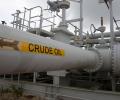
The government has cut windfall profit tax on export of diesel and ATF to their lowest while also reducing the levy on domestically-produced crude in line with softening international oil prices, according to an official order. The levy on crude oil produced by companies such as Oil and Natural Gas Corporation (ONGC) has been cut to Rs 4,350 per tonne from Rs 5,050 per tonne, the order dated February 15 said. Crude oil pumped out of the ground and from below the seabed is refined and converted into fuels like petrol, diesel and aviation turbine fuel (ATF).

Indian stock market benchmark indices Sensex and Nifty experienced a significant drop in early trade due to rising crude oil prices, bearish global market trends, and continuous foreign fund outflows.

The United States conducted retaliatory strikes against Iran, targeting over 80 sites, after accusing Tehran of attacking commercial vessels in the Strait of Hormuz, while Iran condemned the US decision to revoke a temporary suspension of sanctions on Iranian oil sales.

An Indian crew member was killed after a US-owned oil tanker was attacked near Basra, Iraq. Fifteen other Indian crew members were evacuated.
Crude oil volumes on the MCX platform touched a record level of 10.19 million barrels on Wednesday because of increased participation from investors amid high volatility in global crude prices. Although, there was a sharp fall in crude oil prices on Wednesday, but volumes remained upbeat, experts said, adding that prices were below $130 per barrel.
Indian stock market benchmarks Sensex and Nifty rebounded strongly after a two-day decline, driven by falling crude oil prices and positive global cues amid hopes of de-escalation in the Middle East.

The rupee weakened to a record low against the US dollar due to Gulf tensions, rising oil prices, and foreign capital outflows.
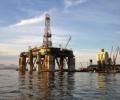
US crude oil futures edged down on Tuesday after hitting an 8-week high of $82 a barrel on Monday.

Iran's Islamic Revolutionary Guard Corps (IRGC) on Sunday claimed it had destroyed eight US military infrastructures in Kuwait and Bahrain in a joint missile and drone operation, describing the strikes as retaliation for a second wave of US military attacks on Iranian targets.
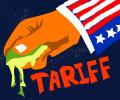
A bipartisan group of US senators has introduced a comprehensive bill imposing extensive sanctions on Russia, with India identified as one of five countries that could incur tariffs for its continued purchase of Russian oil.

Domestic cooking gas (LPG) prices have increased by Rs 29 per cylinder, marking the second hike in three months due to rising global energy costs. This follows broader fuel price increases for petrol, diesel, and CNG, with state-owned retailers still incurring significant losses despite the revisions.
Indian stock markets experienced a significant rally following the announcement of a US-Iran ceasefire, coupled with a drop in crude oil prices. The Sensex and Nifty both closed nearly 4 per cent higher, mirroring gains in global markets.

Indian equity markets experienced a significant downturn, with the Sensex and Nifty plummeting due to rising crude oil prices, geopolitical tensions in West Asia, and continuous foreign fund outflows.

The Indian commodity market has experienced significant growth over the past decade, allowing Indian traders to capitalise on price fluctuations in commodities such as gold, crude oil, and natural gas. Earlier, commodity trading required substantial capital as these contracts were only available in bulk quantities. But to make the commodity market more accessible, exchanges such as the Multi-Commodity Exchange (MCX) have launched smaller and more flexible commodities contracts, including mini and micro contracts. These changes in the commodity lot size have changed the way small traders trade in commodity markets.
